Casino Bonus Terms: What the Fine Print Actually Means
 Rick Martin
Last Updated:
Rick Martin
Last Updated:
A casino throws you a number. "100% up to $500." It sits there on the homepage, bold and inviting, next to a button that says Claim Now. And if you stop reading at that headline, you will walk into the most common trap in online gambling.
Every bonus comes with conditions. Some of those conditions are fair. Others exist specifically to make the bonus look better than it is. The difference between the two is buried in the terms and conditions page, which most players never read because it is written in dense legal language clearly designed to discourage reading. This is the plain-language version of everything you will find in those terms, why each condition exists, and how to figure out whether a bonus is worth your time before you hand over your money.
The Wagering Requirement: The Number That Changes Everything
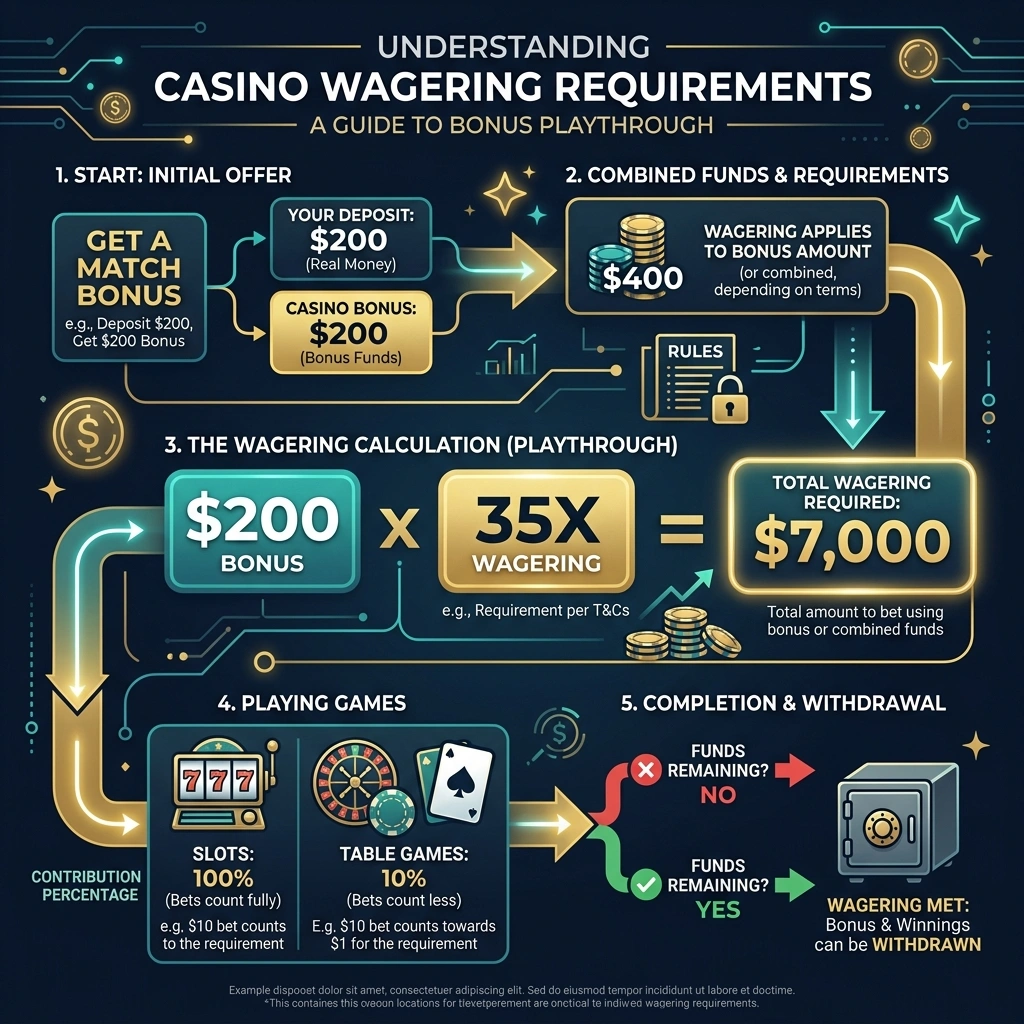
If you learn one thing from this entire page, let it be this. The wagering requirement is the most important number attached to any casino bonus. It is a multiplier that tells you the total amount you need to bet before the bonus money, or anything you won with it, becomes real cash you can withdraw.
Here is how the math works. A casino gives you a $200 bonus with a 35x wagering requirement. You multiply the bonus by the multiplier: $200 x 35 = $7,000. That is the total value of bets you must place before you see a cent of that bonus as withdrawable money. Not win $7,000. Bet $7,000. Those are very different things.
Now factor in the house edge. If you are playing slots with a 96% RTP, the casino keeps about 4% of every dollar you wager. On $7,000 in total wagers, you can expect to lose roughly $280 just from the mathematics of the games. That is more than the $200 bonus itself. The casino designed it that way.
Some bonuses apply the wagering to the bonus amount only. Others apply it to the bonus plus your deposit combined. "35x bonus" on a $200 deposit with a $200 match means $7,000 in required wagers. "35x (bonus + deposit)" on the same amounts means $14,000. That is double the grind and double the expected mathematical loss. You need to read carefully which version is being used because the difference is enormous.
What counts as a reasonable wagering requirement? Anything under 25x is genuinely good and rare. Between 25x and 35x is the industry standard for reputable casinos. 35x to 45x is average, and you will need some luck to come out ahead. Above 45x? The bonus is more of a marketing tool than a real benefit. You can run any numbers through our wagering requirements calculator to see exactly what the expected cost looks like before you commit.
Game Weighting: Not Every Bet Counts the Same
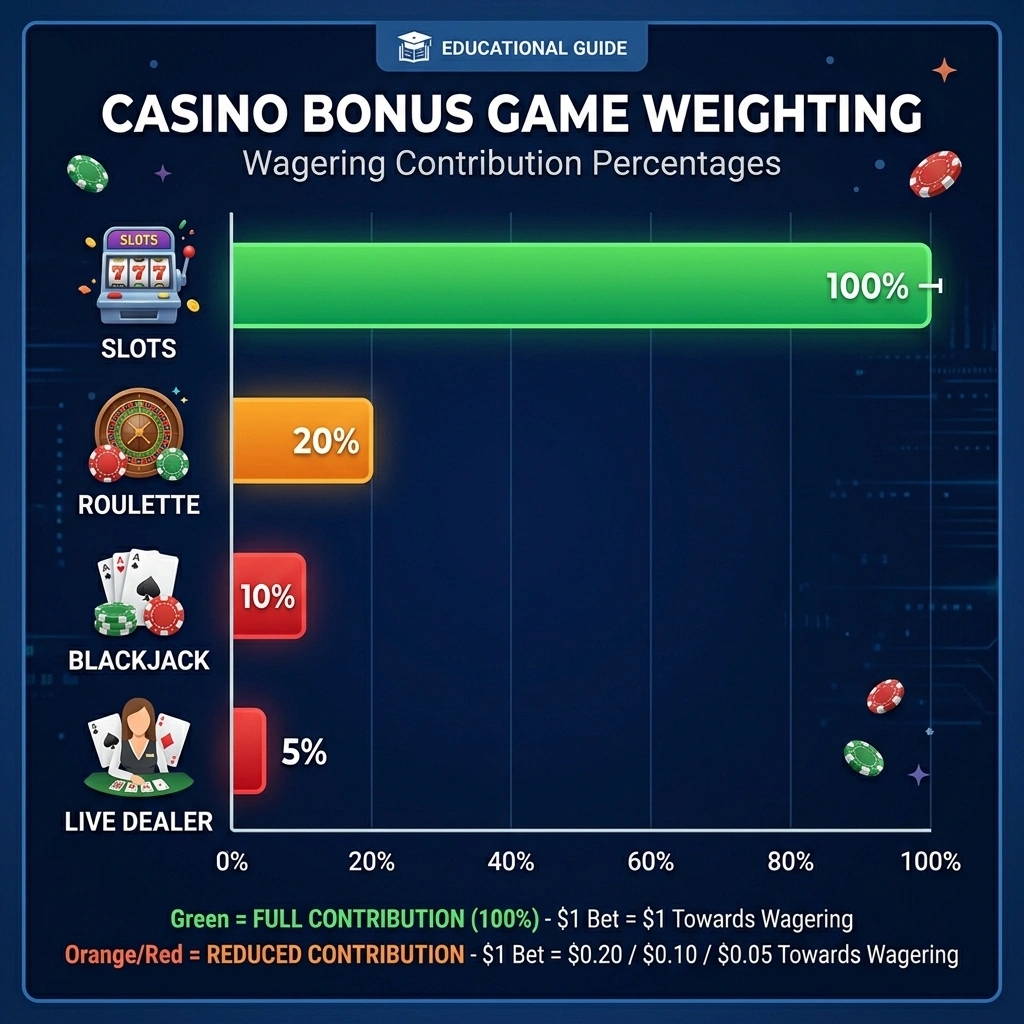
This is the condition that catches people who think they can be clever about their wagering. Game weighting determines what percentage of your wager on a specific game type actually counts toward the wagering requirement.
The standard weighting table at most casinos looks something like this:
- Slots: 100% contribution. A $1 slot bet adds $1 to your wagering progress.
- Blackjack and other table games: 10% to 20%. That same $1 bet only adds $0.10 to $0.20.
- Roulette: 10% to 25%, sometimes higher for specific roulette variants.
- Live dealer games: 5% to 10%, or completely excluded.
- Certain high-RTP slots: 0%. Some casinos exclude specific titles from bonus play entirely.
The logic from the casino's perspective is simple. Table games like blackjack have a much lower house edge (around 0.5% with basic strategy) compared to slots (3% to 5% typically). If they let you clear your entire wagering requirement on blackjack, you would lose far less money in the process. By reducing the weighting on better-odds games, the casino makes sure the wagering costs you a meaningful amount regardless of what you play.
If you are someone who mostly plays Evolution Gaming live tables, here is the uncomfortable truth: most welcome bonuses are essentially worthless to you. A $200 bonus with 35x wagering and 10% live game weighting means you need to place $70,000 worth of bets to clear it. At that point, skip the bonus entirely and play with just your deposited funds.
Always check which specific games are excluded. Some casinos maintain lists of individual slots that do not contribute because they have unusually high RTPs. A game from NetEnt like Blood Suckers (98% RTP) is commonly excluded. If you spend two hours playing an excluded game, your wagering progress stays at zero.
The Max Bet Rule: How $6 Can Cost You Everything
The max bet rule limits how much you can stake on a single spin or hand while playing with bonus funds. The standard limit is $5, though some casinos set it at $8 or $10. Exceed this amount and the casino can void every cent of bonus money and any winnings derived from it.
This is not an exaggeration. Players lose legitimate winnings to this rule every week. You are grinding through your wagering on a slot, you get comfortable, you bump your bet to $6 because you feel like the game is about to pay. The casino's automated monitoring system flags it. You win $800 during that session. When you try to withdraw, the casino points to the max bet violation, and your $800 disappears.
Some casinos are lenient about a first accidental breach, especially if it was a small overage. Others are ruthless and treat any violation as grounds for voiding. You will not know which type of casino you are at until it happens, and by then it is too late.
The practical advice is boring but effective: set your bet to $5 or below the moment you start playing with bonus funds and do not touch it until the wagering is done. If the casino has a $10 maximum bet rule, still play at $5. There is no benefit to pushing the limit.
This rule exists because without it, you could take a $500 bonus, bet $500 on a single roulette spin, and potentially walk away having completed almost none of the wagering. The max bet forces you to grind through the requirement at a pace where the house edge has time to work.
Time Limits: The Clock Nobody Watches
Every bonus has an expiration date for completing the wagering requirement, and most players do not check it until it is too late. The standard window is 30 days, though some casinos give you only 7 or 14 days, and a few generous ones stretch it to 60 or 90 days.
The impact of this restriction depends on how much wagering you need to do and how often you play. A $200 bonus with 35x wagering requires $7,000 in total bets. If you play slots at $1 per spin, averaging about 600 spins per hour, you are wagering $600 per hour of play. That means roughly 12 hours of active play to clear the requirement. Over 30 days, that is perfectly manageable. Over 7 days? You are looking at almost 2 hours per day of dedicated grinding.
When the timer runs out, the casino removes the bonus and any winnings attached to it. Everything gone. And they do not send you a warning the day before. Check the bonus terms page for the exact deadline, mark it somewhere, and make sure you are either going to finish in time or skip the bonus entirely.
Casinos that combine high wagering requirements with short time limits are effectively offering a bonus that almost nobody can profitably clear. A 50x requirement with a 7-day window is a red flag, not an opportunity.
Understanding Every Bonus Type
Match Bonuses
A match bonus doubles or triples your deposit up to a cap. "100% match up to $500" means deposit $500 and get $500 in bonus funds, giving you $1,000 to play with. The match percentage tells you the generosity: 50% is low, 100% is standard, 200% sounds great until you see the wagering requirements that usually come attached to higher percentages.
Do not just look at the match rate in isolation. A 100% match with 25x wagering is better value than a 200% match with 50x wagering. Always use a bonus calculator to compare the actual expected cost of clearing different bonus offers.
No Deposit Bonuses: The Free Lunch That Isn't
No deposit bonuses give you a small amount of free money or free spins just for creating an account. Typically $5 to $25 in bonus cash, or 10 to 50 free spins on a specific slot. No payment required.
The conditions are where reality sets in. No deposit bonuses almost always carry wagering requirements between 40x and 99x, which are significantly higher than standard welcome bonus wagering. A $10 no deposit bonus with 60x wagering means you need to bet $600 before you can withdraw. Combined with a max cashout cap that typically limits you to withdrawing $100 or less, the realistic value is minimal.
Are they worth claiming? As a way to test a casino's interface, game selection, and overall feel without risking anything, yes. As a genuine way to make money, almost never. Think of them as a test drive, not a payday.
What About Sticky Bonuses?
A sticky bonus (sometimes called a non-cashable bonus) is one where the bonus amount itself gets stripped from your balance when you withdraw. You play with $200 in bonus funds, build your balance to $450, request a withdrawal, and the casino subtracts the $200 bonus. You receive $250.
This sounds worse than a regular bonus but the trade-off is that sticky bonuses often have lower wagering requirements. Because the casino knows they are getting the bonus money back regardless, they can afford to be more relaxed about conditions. A sticky bonus with 10x wagering can actually be better value than a cashable bonus with 35x wagering. Do the math before you dismiss it.
Cashback: The Fairest Bonus Type
A cashback bonus returns a percentage of your net losses over a set period. Lose $400 in a week with 10% cashback and you get $40 returned. The calculation uses net losses, so if you deposited $500, won $300, then lost $800, your net loss is $500 and your cashback is $50. Use our cashback calculator to see how different rates affect your bottom line.
The critical question is whether the cashback arrives as real money or as bonus funds. "Real" cashback hits your account as withdrawable cash with no strings. "Bonus" cashback comes with a wagering requirement, usually low (1x to 5x), but it is still a restriction. Always check which version the casino offers.
For regular players who spend significant time at one casino, look for VIP or loyalty programmes with strong cashback rates. Over months of play, the refunded losses compound into meaningful money. It will not make you a winning player, but it softens the impact of the house edge over time.
Reload Bonuses for Existing Players
Reload bonuses are deposit matches offered to existing players. The match rate is usually lower than the welcome offer (25% to 50% instead of 100%), but the wagering requirements are sometimes gentler too. They come in two flavours: scheduled (every Friday, or on your second deposit of the month) and targeted (sent by email when the casino notices you have been quiet).
Targeted reload bonuses are sometimes negotiable. If you are a regular depositor and the casino sends you a weak 25% match with 40x wagering, email customer support and ask for better terms. This works more often than people think. Casinos would rather give you a slightly better offer than lose your business.
Promotional Free Spins: Not What They Seem
Promotional free spins are bonus spins awarded by the casino, separate from the free spins feature inside a slot game. They are played at a fixed bet size, usually $0.10 to $0.25 per spin, on a slot the casino chooses for you. Any winnings are credited as bonus funds with wagering requirements attached.
Win $15 from 50 free spins? That $15 now needs to be wagered 35x before you can withdraw it. That means $525 in total bets to unlock $15. The math is often terrible. "No wagering free spins" do exist and they are genuinely valuable, but most casinos that offer them compensate with strict per-spin or total win caps. Read every line.

Max Cashout Caps: The Invisible Ceiling
A max cashout puts a hard limit on how much you can withdraw from winnings earned with a specific bonus. This is different from a casino's general withdrawal limit. It applies to the bonus specifically.
The worst version of this: you claim a $10 no deposit bonus, grind through 60x wagering, survive the slots for 600 rounds, build your balance to $2,500, and then discover you can only cash out $100. The remaining $2,400 disappears. This happens. It happens often enough that it should be the first thing you check after the wagering requirement.
Max cashout caps are most punitive on no deposit bonuses and promotional free spins. Deposit match bonuses sometimes have them too, but they tend to be higher (5x or 10x the bonus amount). A $200 match bonus with a 10x max cashout means you can withdraw up to $2,000 from that bonus, which is reasonable. A $10 no deposit bonus with a $100 max cashout is less so.
Payment Method Restrictions
This one trips up a surprising number of players. Some casinos exclude certain deposit methods from bonus eligibility. The most commonly excluded methods are Skrill and Neteller. If you deposit using one of these e-wallets, the welcome bonus simply does not activate, and you find out after the fact.
Why do casinos do this? E-wallet deposits are cheaper for the casino to process and are popular among bonus hunters who move between casinos quickly. By excluding these methods from bonus eligibility, casinos filter out some of the players most likely to claim the bonus without making additional deposits.
PayPal is usually safe for bonus eligibility in most markets, though a few operators exclude all e-wallets regardless. Visa and Mastercard deposits almost always qualify. Bitcoin eligibility varies wildly and is often tied to whether the casino even offers a standard welcome bonus for crypto deposits (many have separate crypto-specific promotions instead).
Check the bonus terms before you deposit. The payment method restriction is always listed, but it is usually buried three paragraphs into the fine print.
What "Bonus Abuse" Actually Means
Bonus abuse is a term casinos use broadly, and sometimes too broadly. The obvious cases are clear: creating multiple accounts to claim the same welcome bonus repeatedly, using stolen payment methods, or colluding with other players to move money through the system. Nobody disputes that these should be prohibited.
The grey area is where problems start. Some casinos flag players who only ever deposit during bonus periods. Others consider it suspicious if you withdraw immediately after completing wagering without making additional bets. A few operators have voided legitimate five-figure wins by retrospectively claiming the player's betting pattern constituted "irregular play" that violated bonus terms.
Protect yourself by choosing casinos with solid reputations for paying winners. Read reviews, especially from players who describe their withdrawal experiences. Check our casinos to avoid list. And avoid doing anything that is clearly gaming the system, like creating duplicate accounts or using VPNs to claim geo-restricted promotions.
Evaluating Any Bonus in Under a Minute
Here is a quick checklist you can run through before you claim anything:
- Wagering requirement. Under 35x on the bonus only? Proceed. Over 45x? Think twice. Over 60x? Walk away.
- Game weighting. Do the games you actually play contribute 100%? If not, recalculate the effective wagering requirement.
- Max bet during wagering. Is it $5 or higher? Lower than $5 is unusual and annoying.
- Time limit. Can you realistically complete the wagering within the window based on how often you play?
- Max cashout. Is there a withdrawal cap? If yes, is the cap high enough to be worth the grind?
- Payment method. Does your preferred deposit method qualify for the bonus?
- Sticky or cashable? If sticky, adjust your expectations about the withdrawal amount.
If any of those checks return a bad answer, consider skipping the bonus. Playing without a bonus means no wagering requirements, no max bet restrictions, and no time pressure. Every dollar you deposit is real money from the start, and you can withdraw whenever you want.
The Expected Value Calculation
For people who like to get specific about the math, here is how to calculate the expected value of a casino bonus.
Take the bonus amount. Subtract the expected loss during wagering. The expected loss is: (total wagering amount) x (average house edge of the games you will play). If you are playing slots with roughly 4% house edge:
$200 bonus, 35x wagering on bonus in wagers.
Expected loss: $7,000 x 0.04 = $280.
Expected value of the bonus: $200 - $280 = -$80.
That bonus is expected to cost you $80 over and above what you would lose playing without one. It has negative expected value, which means claiming it makes you worse off on average than not claiming it. Not every bonus works out this way, though. Let us run a better offer:
$200 bonus, 20x wagering on bonus in wagers.
Expected loss: $4,000 x 0.04 = $160.
Expected value: $200 - $160 = +$40.
That is a positive expected value bonus. On average, across many claims, you come out $40 ahead. Those are the bonuses worth claiming. Use our bonus calculator to run these numbers instantly for any offer you are considering.
When You Should Skip the Bonus Entirely
This is the advice that no affiliate site wants to give you, but it is honest. There are situations where you are genuinely better off declining the bonus and playing with your own deposited funds.
- You play mostly table games or live dealer. With 10% or 0% game weighting, the effective wagering requirement is absurdly high. A 35x requirement with 10% weighting means you effectively need to wager 350x on live games. Skip it.
- The wagering requirement is above 45x. The math almost never works in your favour. You will lose more clearing the bonus than the bonus is worth.
- You play casually with small deposits. If you deposit $20 and play once a week, a 30-day wagering deadline will expire before you come close to finishing. The bonus becomes pressure to play more than you want to, which defeats the purpose of gambling as entertainment.
- You value freedom. Without a bonus, you can withdraw at any time. No wagering pressure. No max bet restrictions. No time limits. No stress about voided winnings. For many players, that peace of mind is worth more than the bonus.
If you do claim a bonus, treat the wagering as a project with a deadline and a budget. Know exactly how much you need to wager, how long you have, and what your expected loss will be. If the numbers do not work, clicking "No thanks" on the bonus screen is one of the smartest things a casino player can do.
Licensing and How It Affects Bonus Fairness
The regulator behind a casino's licence affects how bonus terms are enforced. Casinos licensed by the UK Gambling Commission operate under stricter rules than most: bonus terms must be transparent, unfair conditions can be challenged, and the regulator has historically fined operators for misleading promotions.
The Malta Gaming Authority also maintains high standards and handles player complaints about bonus disputes. If you feel a casino has unfairly voided your bonus or winnings, having an MGA licence means there is a formal complaint process with actual enforcement behind it.
Curacao-licensed casinos operate with significantly less oversight. Bonus terms at these casinos can be vaguer, enforcement is more aggressive against players, and the dispute resolution options are limited. Not all Curacao casinos are bad actors, but if a bonus dispute arises, your options are fewer.
If bonus fairness is a priority for you, and it should be, favour casinos regulated by authorities that actively police promotional practices. Read about the different casino licences and what each one actually means for players before you sign up.
The Big Picture on Casino Bonuses
Casino bonuses are not gifts. They are customer acquisition tools. The casino is spending money to get you through the door because they know the house edge will, on average, earn that money back and then some over the course of your wagering requirement. That is the business model, and there is nothing wrong with understanding it clearly.
Your job as a player is to identify the offers where the math tilts slightly in your favour, or at worst costs you less than the entertainment value you get from the extra playtime. A $200 bonus that costs you $50 in expected losses after wagering is effectively a $150 discount on your entertainment. That can be a perfectly good deal. A $200 bonus that costs you $280 in expected losses is literally worse than no bonus at all.
Read the terms. Run the numbers. And remember that the casino wrote those terms to benefit themselves, not you. Your advantage is that you can do the math, and now you know exactly which conditions to look for.
For quick lookups on any individual term mentioned here, check our casino glossary where every concept is explained in plain language with real-world examples.