What Is RTP in Slots and Why It Matters
 Rick Martin
Last Updated:
Rick Martin
Last Updated:
Every slot machine has a number attached to it that most players scroll right past. It is called RTP, which stands for Return to Player, and it is one of the most important pieces of information available to you before you press spin. Understanding what it means will not guarantee wins, but it will help you avoid games that are stacked more heavily against you than they need to be.
RTP in Plain Language
RTP is a percentage that represents how much of the total money wagered on a slot gets paid back to players over a very long period. A slot with an RTP of 96% is designed to return $96 for every $100 wagered, on average, across millions of spins.
The remaining percentage is the house edge. In this case, that is 4%. That is how the casino makes its money. Every game has a built-in mathematical advantage for the operator, and what RTP tells you is how large or small that advantage is.
It is important to understand that RTP is calculated over an enormous sample size. In any single session, your results will vary wildly. You might win five times your deposit or lose everything in twenty minutes. RTP does not predict short-term outcomes. It describes long-term mathematical behavior.

What Numbers Should You Look For?
In today's market, the average online slot RTP sits around 96%. Here is a rough guide to help you evaluate what you are looking at:
- Above 97%: Excellent. These are player-friendly slots. Examples include games from NetEnt like Blood Suckers (98%) and select Pragmatic Play titles.
- 95 to 97%: Average to good. Most popular slots fall in this range.
- 93 to 95%: Below average. You are giving the casino a larger edge than necessary.
- Below 93%: Worth avoiding unless you have a specific reason. These are more common in land-based casinos but occasionally appear online as well.
Some providers are known for consistently higher RTPs. NetEnt and Play'n GO tend to design games in the 96 to 97% range. Others vary more widely, so always check the individual game rather than assuming based on the studio name alone.
Where to Find a Slot's RTP
Most reputable online slots display their RTP in the game information or help section. You can usually access it through a menu icon or question mark button within the game itself. If a casino does not show the RTP anywhere, treat that as a red flag. Transparency matters, and operators who hide this information are not doing you any favors.
You can also find RTP data on provider websites and independent review platforms. Some casinos even list RTP percentages in their game library filters, which makes comparison straightforward. Our House Edge Calculator can help you see exactly what a given RTP means for your bankroll over a full session.
RTP vs Volatility: Two Different Things
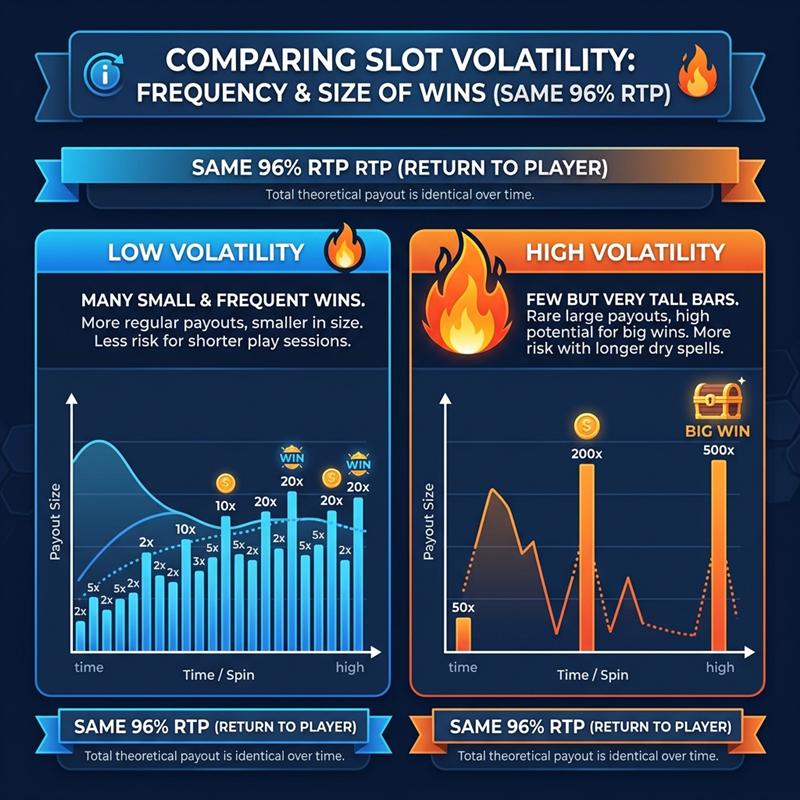
This is where many players get confused. RTP tells you how much comes back over time. Volatility tells you how that money comes back, whether in frequent small wins or rare large ones.
A low-volatility slot with 96% RTP will pay out often but in modest amounts. A high-volatility slot with the same 96% RTP might go through long dry spells before delivering a substantial payout. Both return the same percentage over millions of spins, but the experience of playing them is completely different.
Choosing between them depends on your bankroll and your patience. If you have a smaller budget and want longer play sessions, low volatility is your friend. If you are comfortable with risk and chasing bigger wins, high volatility is more exciting, though it requires a larger bankroll to survive the inevitable cold streaks. For a deeper look at this topic, read our guide on slot volatility.
Can Casinos Change the RTP?
This depends on the provider and the licensing jurisdiction. Some game providers allow operators to choose from preset RTP configurations. For example, a slot might be available in 96.5%, 94.5%, and 92% versions, and the casino selects which version to offer its players.
Casinos licensed by strict regulators like the UK Gambling Commission or the Malta Gaming Authority are generally required to disclose the actual RTP being offered. Less regulated casinos may run lower-RTP versions without making it obvious to the player.
This is another reason to play at properly licensed casinos. You are more likely to get the standard RTP configuration rather than a quietly reduced one.
The Bottom Line
RTP will not tell you whether you will win tonight. What it will tell you is which games give you a fairer mathematical chance over time. All else being equal, choosing a 97% RTP slot over a 93% one means the casino keeps less of your money in the long run. That is not a guarantee. It is just smarter play.
Check the RTP before you spin, understand what it means, and use it alongside volatility to pick games that match both your budget and your style.