RTP, Variance, and House Edge: What These Numbers Actually Mean
 Rick Martin
Last Updated:
Rick Martin
Last Updated:
Walk into any online casino lobby and you will see hundreds of games. Pick one at random and you might have a great session. Pick another and you will burn through your deposit in ten minutes. The difference between those experiences comes down to three numbers that most players never bother to look up: RTP, variance, and house edge.
These are not complicated concepts. Each one takes about two minutes to understand. But together they form the foundation of everything that happens when you place a bet at an online casino. If you play without understanding them, you are making decisions in the dark. If you do understand them, you still will not win every session, but you will at least know what you are getting into.
RTP: What the Casino Pays Back Over Time
RTP stands for Return to Player and it is expressed as a percentage. A slot with 96.5% RTP is designed to return $96.50 for every $100 wagered across millions of spins. The remaining $3.50 is the casino's cut.
Two things about this number that confuse people. First, the sample size. RTP describes what happens over millions of rounds, not over your Tuesday night session. In 200 spins, your personal return might be 40% or 250%. The percentage only settles near the published figure after an enormous volume of play. Second, RTP does not tell you anything about how winnings are distributed. Two slots can both have 96% RTP but deliver completely different experiences. One might pay small amounts constantly. The other might eat your balance for an hour and then drop a massive payout. Same long-term return, wildly different short-term behaviour.
Where should you look for this number? Most slots display it in the game information section, usually behind a question mark or "i" icon within the game itself. Pragmatic Play puts it in the game rules. NetEnt includes it in the help menu. If a casino or game hides the RTP entirely, that is a signal to play something else. Transparency is the bare minimum.
What RTP Numbers Are Good?
The online slot market averages around 96%. Here is a rough scale:
- Above 97%: Excellent. Player-friendly slots. NetEnt's Blood Suckers sits at 98%. Titles from Nolimit City and Hacksaw Gaming sometimes push above 97%.
- 95% to 97%: Average to good. The majority of popular slots fall in this range.
- 93% to 95%: Below average. You are giving the casino a bigger edge than you need to.
- Below 93%: Poor. More common at land-based casinos or in mobile games, but they occasionally appear online. Avoid them unless you have a specific reason.
Table games have different reference points. Blackjack with basic strategy can run above 99.5% RTP (house edge under 0.5%). European roulette sits at 97.3%. Baccarat banker bet is about 98.94%. These numbers are fixed by the rules of the game. Slots, by contrast, vary enormously depending on the game and sometimes the casino.
Can Casinos Change the RTP?
Yes. Some game providers offer operators a choice of RTP configurations. A slot might be available in 96.5%, 94.5%, and 92% versions. The casino picks which one to run. This means the same slot title can have different RTPs at different casinos.
Casinos regulated by the UK Gambling Commission must disclose the actual RTP being offered, not just the default one. The Malta Gaming Authority has similar requirements. At Curacao-licensed casinos, disclosure standards are weaker. You might be playing a 94% version of a slot that is advertised as having 96.5% RTP on the provider's website.
If you want to verify the RTP at a specific casino, check the game's info screen within the casino itself, not the provider's general spec sheet. And when the RTP shown in-game differs from what you expected, trust the in-game version. That is the actual configuration running on that server.
Variance: How the Ride Feels
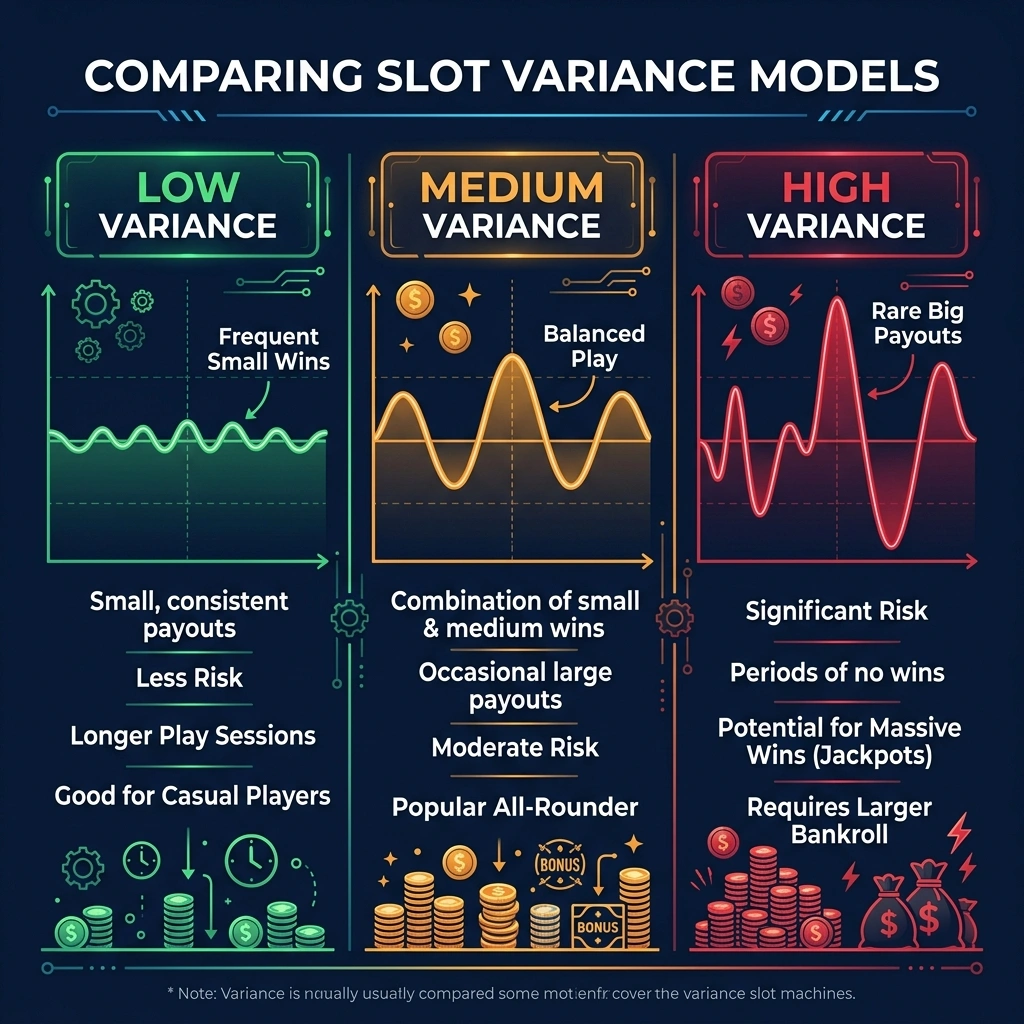
If RTP tells you the destination, variance tells you how bumpy the road is getting there. Variance (sometimes called volatility) describes the risk profile of a game. It answers the question: how are the payouts distributed?
Low Variance
A low-variance slot pays out frequently in small amounts. Your bankroll chart looks like a gently declining line with minor bumps. You land wins on roughly every third or fourth spin but they rarely exceed 2x to 5x your bet. Sessions feel smooth and predictable. You will not lose your entire deposit in twenty spins, but you also will not hit anything life-changing. Starburst is the textbook example.
Low variance is ideal if you play with a limited budget and want to stretch your playing time. It is also what casinos favour for bonus promotional free spins because it keeps the average payout per spin low.
Medium Variance
Medium variance sits in between. Wins are less frequent than low variance but larger when they land. You will see dry spells of 10 to 20 spins regularly, punctuated by wins in the 10x to 50x range. This is where the majority of popular online slots live. Games like Book of Dead and Gonzo's Quest are classic medium-variance titles. Your bankroll swings more noticeably but rarely in a way that feels completely out of control.
High Variance
High variance slots are feast or famine. Your balance might drop for 100, 200, or even 300 spins without any meaningful win. Dead spins pile up and the session can feel hopeless. Then the bonus round triggers and you hit something enormous: 500x, 1,000x, or in extreme cases 10,000x your bet. The entire session's return concentrates into a handful of moments.
Slots from Nolimit City (Mental, San Quentin), Hacksaw Gaming (Wanted Dead or a Wild), and Push Gaming (Jammin' Jars) tend toward high variance. Gates of Olympus from Pragmatic Play is one of the most popular high-variance slots globally. The multiplier mechanic during free spins is what creates those headline payouts.
High variance demands respect. You need a bankroll that can survive the cold streaks. A general rule: budget at least 200 to 300 times your bet size for a high-variance session. If you are spinning at $1 per round, bring at least $200 to $300. Anything less and you are likely to bust before a feature ever triggers. Our bankroll calculator can show you exactly how many spins different budgets will sustain at different bet levels.
How to Find a Slot's Variance
Unlike RTP, variance is not always displayed in the game itself. Some providers include it in the paytable or game rules, labelled as "volatility" with a rating of low, medium, or high. Others skip it entirely. Pragmatic Play uses a 5-point scale (from 1 to 5 lightning bolts) which is helpful. NetEnt sometimes includes it, sometimes does not.
If the game does not show its variance, look at the paytable structure. A slot where the top regular symbol pays 50x your bet and has a max win of 10,000x or higher is almost certainly high variance. A slot with a max win capped at 1,000x and regular symbols paying 2x to 5x is low to medium. The max win cap is one of the most reliable indicators of variance when no official rating is available.
You can also test variance yourself using our slot variance simulator. Plug in the numbers and run simulated sessions to see how your bankroll would behave.
House Edge: The Price of Playing
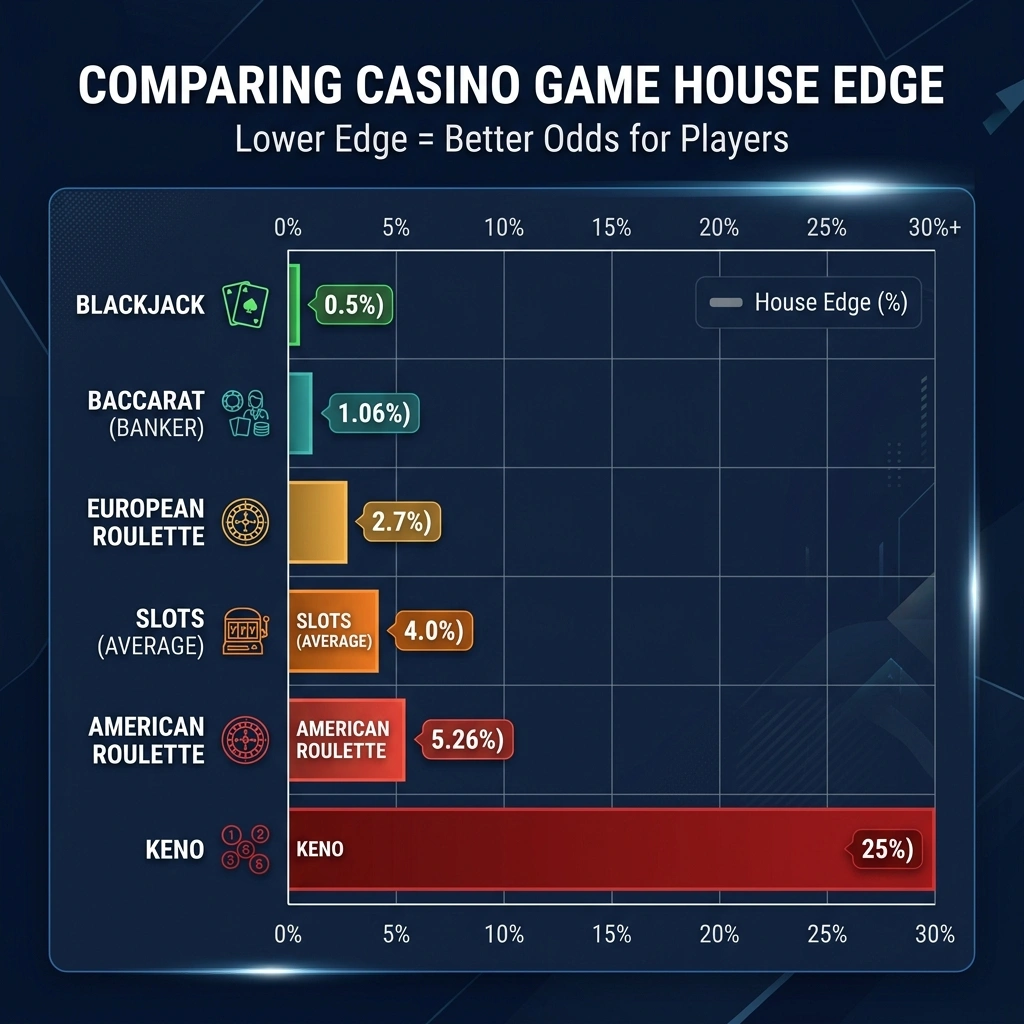
The house edge is simply 100% minus the RTP. If a slot has 96% RTP, the house edge is 4%. If blackjack with basic strategy gives 99.5% RTP, the house edge is 0.5%. This percentage is what the casino earns from your play over time. It is the price of admission.
Across every casino game, the house edge works like gravity. In any individual session, you can beat it through luck. But over thousands of bets, it pulls the numbers in the casino's direction. Understanding this does not mean you should not play. It means you should know the cost of playing and choose games that charge you less.
House Edge Across Different Games
The differences between games are substantial:
| Game | Typical House Edge |
|---|---|
| Blackjack (basic strategy) | 0.5% |
| Baccarat (banker bet) | 1.06% |
| Craps (pass line) | 1.41% |
| European Roulette | 2.7% |
| American Roulette | 5.26% |
| Online Slots (average) | 3% to 5% |
| Keno | 20% to 40% |
Notice the range. Playing blackjack with proper strategy versus playing keno is the difference between paying the casino 50 cents per $100 wagered and paying $25 per $100 wagered. If you care about maximising your playing time relative to your budget, game selection is the single most impactful decision you make. Use our house edge calculator to compare the cost of different games over any number of rounds.
Why Slots Are More Expensive Than They Look
A 4% house edge on slots sounds modest until you factor in the speed of play. A slot player averages 500 to 700 spins per hour. At $1 per spin, that is $500 to $700 wagered per hour. With a 4% house edge, the expected loss is $20 to $28 per hour.
A blackjack player at a lively online table might play 60 to 80 hands per hour. At $10 per hand, that is $600 to $800 wagered, but with a 0.5% house edge the expected loss is only $3 to $4 per hour. The blackjack player is wagering a similar total amount but losing far less because the game itself takes a smaller cut.
Speed times house edge equals your actual cost per hour. Slots spin fast and have a higher edge. Table games are slower with a lower edge. This is why experienced players who track their expenses gravitate toward table games, even though the individual bet sizes are often higher.
How These Three Numbers Work Together
You need all three numbers to understand a game. Here are some examples of how they interact:
A slot with 94% RTP and low variance is the worst of both worlds. It pays out frequently but takes a larger bite from each dollar wagered. Your bankroll declines steadily without the possibility of a big hit to recover. Avoid these.
Flip that around. A slot with 97% RTP and high variance is mathematically generous over time, but individual sessions will be brutal. Long losing streaks followed by occasional massive payouts. If you have the bankroll and the patience, these are the best value slots available. You just have to survive the cold streaks to reach the payoffs.
Most popular slots sit somewhere in the middle. 96% RTP, medium volatility. Balanced sessions with a mix of small wins, some dry periods, and occasional nice payouts. Nothing extreme in either direction. Comfortable to play but not particularly exceptional in value.
Table games are a different animal entirely. European roulette has 97.3% RTP (2.7% house edge) and effectively medium variance because any single bet can double your money or vanish. But the payout table is fixed and transparent. There are no hidden configurations, no bonus rounds, no variable RTP. What you see is exactly what you get. That transparency has value even if the RTP is not the highest available.
Practical Tips for Using These Numbers
Before You Play
- Check the RTP. Open the game info screen and confirm the actual RTP at this casino. Not the one listed on the provider's website. The one running on the server you are about to play on.
- Assess the variance. Look at the max win, the paytable, and any published volatility rating. If no rating is available, the max win cap gives you a ballpark.
- Match your bankroll. Low variance? You can play comfortably with 50 to 100 bets. High variance? Budget 200 to 400 bets minimum.
- Decide on a session limit. Calculate your expected loss per hour (bet size x spins per hour x house edge) and set a loss limit that keeps gambling in the entertainment category. If the math says you will lose $20 per hour on average, two hours costs roughly $40. Decide if that is reasonable entertainment spending for you.
During Your Session
Your results will deviate from the mathematical expectation. Wildly. In a hundred spins, you might land at 150% return or 30% return. Both are normal. The RTP is a destination that your results orbit around at a great distance during short sessions. Do not use a hot or cold streak as evidence that the math is wrong. The math is not wrong. You are just experiencing variance.
If you are playing a high-variance slot and your balance drops significantly, that is normal behaviour for the game. It is not "rigged". The random number generator does not know how much money is in your account. It does not know your name. Each spin is independent.
After Your Session
Resist the temptation to chase losses. If you set a session budget of $100 and you lost $100, the session is over. The RTP and house edge do not remember your previous session. Tomorrow's spins are mathematically independent of today's results. Chasing losses is the single fastest way to turn a moderate loss into a catastrophic one.
If you find yourself regularly spending more than you planned, set deposit limits directly through the casino's responsible gambling tools. Every properly licensed casino offers daily, weekly, and monthly limits. Using them is not a sign of weakness. It is using the math in your favour instead of against you.
Common Myths That These Numbers Disprove
"This slot is due for a payout." No. Each spin is independent. A slot that has not paid in 500 spins is no more likely to pay on spin 501 than on spin 1. The RNG resets with every spin. There is no payout queue.
Another common one: "I always lose more at certain times of day." The RTP does not change based on time, day of the week, or how many other people are playing. Casino games are not like airline tickets with dynamic pricing. The math is constant.
People also assume that high-RTP slots must be boring. They are not. Some of the most exciting slots in the market, including many Megaways titles and bonus buy games, run at 96% or higher. RTP and entertainment value are separate variables.
The most paranoid myth is that casinos adjust the RTP when you are winning. Licensed casinos cannot change the RTP mid-session. The configuration is set at the server level and audited by independent testing labs like eCOGRA. Changing it on the fly would be fraud, and it would show up in audits. If you are playing at a properly licensed casino, this is not happening.
Where to Go from Here
You now have the framework to evaluate any casino game before you play it. Look up the RTP, get a feel for the variance, and calculate what the house edge will cost you over time. Then match all three against your bankroll and your risk tolerance.
For specific term definitions, our casino glossary covers every concept mentioned here in individual detail. For running numbers on specific scenarios, the calculator suite lets you model wagering costs, bankroll duration, house edge comparisons, and variance outcomes.
None of this makes you a guaranteed winner. Nothing can. But it makes you an informed player, and that is the only real edge available in a game where the mathematics are decided before you sit down.