KYC and Casino Withdrawals: From Document Upload to Money in Your Account
 Rick Martin
Last Updated:
Rick Martin
Last Updated:
You hit a decent win. You click withdraw. And then the casino asks you to photograph your passport, dig up a utility bill from the last three months, and take a selfie while holding your ID next to your face. If this is your first time, it feels invasive and slow and possibly like a stalling tactic. It is not. What you are experiencing is KYC verification, and every licensed casino on the planet is legally required to do it before they send you money.
Understanding how this process works before you deposit saves you frustration, delays, and the unpleasant surprise of having your withdrawal held up because your documents were not right. This page covers the entire journey from your first deposit to the moment the money arrives in your bank account or e-wallet.
What KYC Is and Why Casinos Do It
KYC stands for Know Your Customer. It is a set of regulations borrowed from banking that require gambling operators to verify the identity of every customer who requests a withdrawal. The reasons behind it are straightforward and legitimate:
- Preventing money laundering. Anti-money laundering laws require casinos to confirm that the money flowing through their platform comes from legitimate sources.
- Stopping underage gambling. Verifying your identity confirms you are of legal age in your jurisdiction.
- Protecting you. KYC makes sure the person withdrawing funds is the same person who deposited them. Without it, anyone who accessed your account could drain your balance.
- Keeping the licence. Regulators like the UK Gambling Commission and the Malta Gaming Authority audit casinos on their KYC compliance. Poor KYC practices result in fines, sanctions, and licence revocation.
This is not the casino being difficult. It is the casino complying with the law. Any licensed operator that lets you withdraw significant amounts without verifying your identity is cutting corners that could put your money at risk.
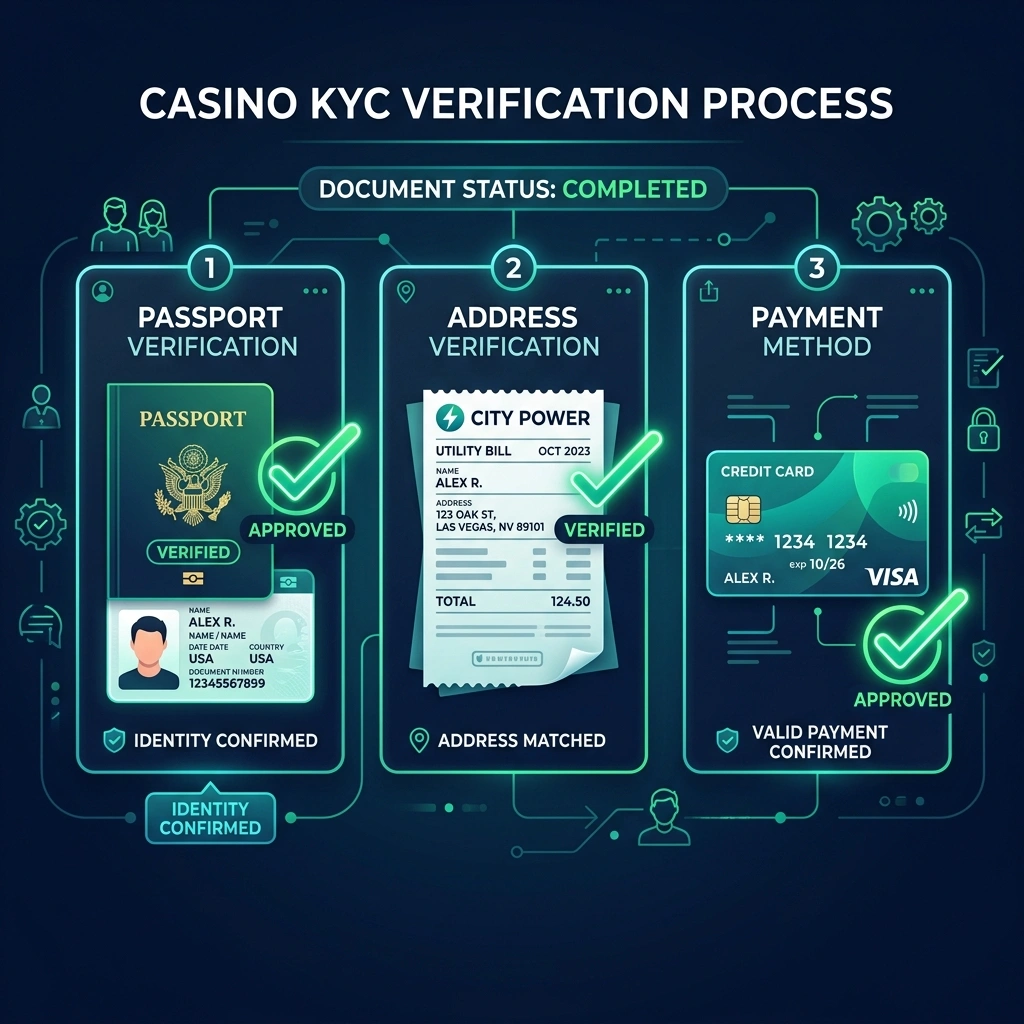
The Three Documents You Need
Standard KYC requires three categories of proof. Having them ready before you play saves days of waiting later.
1. Proof of Identity
A government-issued photo ID. The accepted options are a passport, a national identity card, or a driving licence. The document must be valid and not expired. If it is a card (national ID or driving licence), you will usually need photos of both sides. The image must show all four corners of the document, your photo must be clear, and any text must be legible. No cropping, no shadows, no fingers covering the edges.
This is where the majority of rejections happen. Blurry photos taken in poor lighting with half the document cut off are the number one reason KYC gets delayed. Lay the document flat on a table, use good lighting, and take the photo from directly above. Ten seconds of effort here saves 48 hours of back-and-forth with the compliance team.
2. Proof of Address
A document that confirms where you live. Accepted options include a utility bill (electricity, gas, water, internet), a bank statement, or an official government letter. The document must be dated within the last three months and must clearly show your full name and residential address. Mobile phone bills are accepted by some casinos and rejected by others. Payslips rarely qualify.
The most common mistake here is submitting a document older than three months. Casinos enforce this deadline strictly. If your latest utility bill is from four months ago, it will be rejected regardless of how clearly it shows your name and address. Keep a recent PDF of a utility bill saved somewhere accessible. When the casino asks, you can upload it within minutes instead of scrambling to find one.
3. Proof of Payment Method
This confirms that the payment method used to deposit actually belongs to you. Requirements vary based on what you deposited with:
- Credit or debit card: A photo showing the first six and last four digits. The middle numbers should be covered for security. Your name on the card must be visible.
- E-wallet (Skrill, Neteller, PayPal): A screenshot of your e-wallet account showing your name and registered email address.
- Bank transfer: A bank statement or screenshot showing the transfer to the casino, with your name and account details visible.
- Cryptocurrency (Bitcoin, Ethereum): Requirements vary. Some casinos request a screenshot of the transaction from your wallet. Others only require proof of identity and address.
When KYC Gets Triggered
Most casinos let you deposit and play without completing KYC. The verification process typically kicks in at one of these points:
- Your first withdrawal request, regardless of amount.
- When your total deposits cross a threshold. The most common trigger is €2,000 cumulative deposits, mandated by EU anti-money laundering regulations.
- When the casino's automated risk system flags your account for review, which can happen randomly.
- At registration, if the casino uses automated identity verification (increasingly common at UKGC-licensed casinos, where verification before play is now required).
Some modern casinos run "instant KYC" at registration using automated verification services. You take a photo of your ID and a selfie through your phone camera, the system matches your face to the ID photo, and verification completes in under two minutes. This is becoming more common and it is genuinely better for everyone. You get verified immediately, and when you win, the withdrawal processes without any document delays.
How Long Verification Takes
If your documents are clear, correct, and recent, most casinos complete KYC within 24 to 48 hours. Well-staffed operations can turn it around in a few hours. Some casinos are notorious for taking 72 hours or longer, especially if their compliance department is small or if they process verifications in batches.
The delays that frustrate players almost always come from one of these issues:
- Blurry or poorly lit photos where text is not readable.
- An expired ID that you did not notice was out of date.
- An address document older than three months.
- A name mismatch. If you registered as "Mike Johnson" but your passport says "Michael Johnson," some casinos will flag it.
- Missing corners on the document photo.
Fix these common problems before submitting and you eliminate 90% of the reasons KYC gets delayed.
The Withdrawal Process: Step by Step
Once your KYC is approved, here is what happens when you request a withdrawal.
Step 1: You Request the Withdrawal
You choose your withdrawal amount and payment method from the casino's cashier section. Most casinos require you to withdraw to the same method you deposited with, at least up to the deposit amount. This is an anti-money-laundering requirement. If you deposited $300 via Visa, the first $300 of withdrawals must go back to that Visa card. Anything above that can go to a different method.
Step 2: The Pending Period
After you submit the withdrawal, it enters a pending period. This is a gap between your request and the casino actually processing the payment. The best casinos have zero or near-zero pending periods. Average casinos take 24 to 48 hours. Slow ones stretch to 72 hours, sometimes adding "business days only" which means a Friday withdrawal might not process until Tuesday.
During this pending period, some casinos offer a reverse withdrawal button. This lets you cancel your withdrawal and put the money back into your playable balance. This feature exists for one reason: to give you a chance to change your mind and gamble the money away. Some of the best operators in the industry have removed this option entirely, and that decision tells you a lot about whether a casino is designed to pay you or to keep you playing.
If a casino offers reverse withdrawal and you find yourself tempted, close the browser tab. Come back when the pending period is over and the money has been sent. That button has cost players more money than any single casino game.
Step 3: Processing and Transit
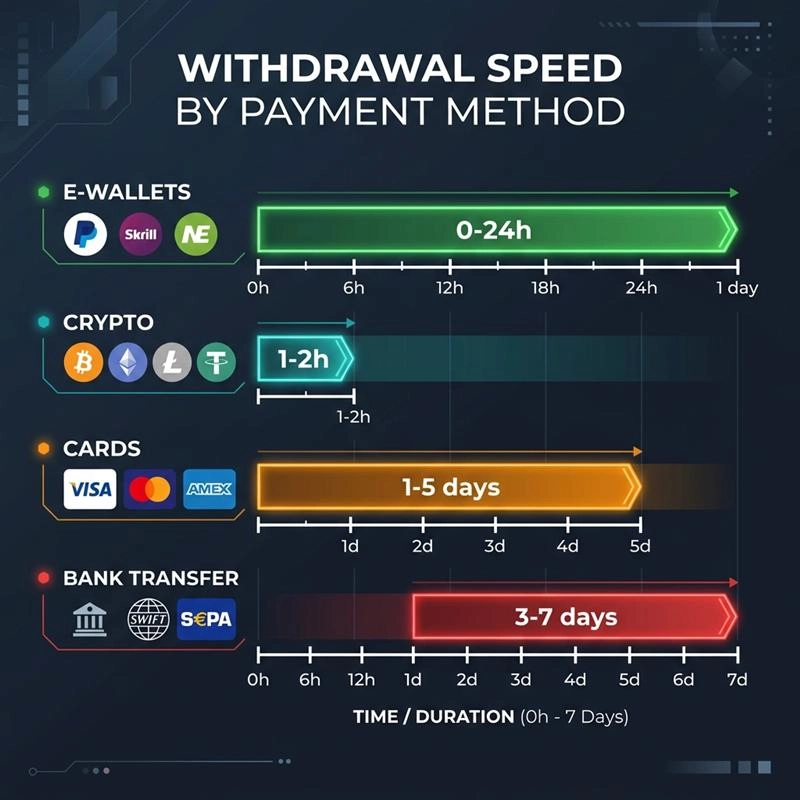
Once the pending period ends, the casino releases the payment. How quickly the money actually arrives depends entirely on your payment method:
- E-wallets (Skrill, Neteller, MuchBetter): Minutes to a few hours. This is the fastest option at virtually every casino.
- Cryptocurrency (Bitcoin, Ethereum, USDT): Usually within an hour once the casino releases it, though blockchain confirmation times add 10 to 60 minutes depending on network traffic.
- Debit and credit cards (Visa, Mastercard): 1 to 5 business days. The delay is on the banking network side, not the casino.
- Bank transfers: 3 to 7 business days. The slowest option but available everywhere.
- Trustly: Usually same-day or next business day. Increasingly popular in Nordic and European markets.
If speed matters to you, deposit via e-wallet or crypto and withdraw the same way. Card and bank transfer withdrawals are not slow because the casino is stalling. The banking system simply moves at its own pace. Our processing time glossary entry breaks down timing by method in more detail.
Withdrawal Limits
Most casinos cap how much you can withdraw within a given period. Standard limits look something like $5,000 to $10,000 per week, or $20,000 to $50,000 per month. VIP players often get higher or unlimited withdrawal caps.
If you win a large amount, say $50,000 from a jackpot or a lucky bonus round, a casino with a $10,000 weekly withdrawal limit will pay you out over five weeks. The money is safe (at properly licensed casinos your funds must be held in segregated accounts), but you will receive it in instalments rather than all at once.
These limits are listed in the casino's terms and conditions. Check them before you deposit if you play at bet levels where a big win is possible. A casino with a $2,000 weekly withdrawal limit is fine for casual players but becomes a problem if you are playing $50 per spin on high-variance slots.
Source of Funds: The Extra Check for Big Players
If your deposits are unusually large or frequent, the casino's compliance team may ask for source of funds documentation. This is a step beyond standard KYC. They want to see evidence that the money you are depositing comes from a legitimate source.
Typical documents requested include recent payslips, a bank statement showing your salary deposits, proof of a property sale, inheritance documentation, or business revenue records. This requirement comes from AML regulations and it tends to trigger at cumulative deposit thresholds, often around €10,000 to €20,000, though some casinos set lower triggers.
Source of funds checks can feel intrusive, but they are routine at properly regulated casinos. Provide the documentation promptly and honestly. If a casino asks for your source of funds, it means their compliance system is working correctly, not that they are trying to avoid paying you.
What to Do If a Casino Delays Your Withdrawal
If your withdrawal has been pending for longer than the casino's stated processing time, here is a practical escalation path:
- Contact live chat. Ask for a specific reason and a timeline. Document the conversation with screenshots.
- Submit a formal complaint through the casino's complaint process. Every licensed casino is required to have one.
- Escalate to the regulator. The MGA and UKGC both have player complaint portals. eCOGRA also handles disputes for certified casinos. Filing with the regulator usually gets a fast response because the casino does not want regulatory scrutiny.
- Post about your experience on player forums. Public accountability matters. Casinos monitor their reputation on communities like AskGamblers and CasinoMeister. A detailed, factual post about a delayed withdrawal often accelerates resolution.
Casinos that routinely delay withdrawals or find excuses to avoid paying are eventually blacklisted by the community. Check our casinos to avoid list before depositing. Prevention is always easier than dispute resolution.
Crypto Withdrawals: Faster but Different
Withdrawals at crypto casinos work differently in a few important ways. Because cryptocurrency transactions are pseudonymous, KYC requirements at some crypto-only casinos are lighter or deferred to higher thresholds. Some do not require KYC at all for withdrawals below certain amounts.
Speed is the obvious draw. Bitcoin and Ethereum withdrawals often complete within 30 minutes once the casino releases them. No pending period, no banking delays, no business-day restrictions.
But that speed comes with a trade-off in protection. Most crypto casinos hold Curacao licences or operate without any licence. If something goes wrong, your options for recourse are limited. There is no regulator to escalate to, no fund segregation requirement protecting your deposits, and no formal dispute resolution process. The faster withdrawals come with the trade-off of operating in a less regulated environment.
For players who value both speed and security, the best approach is to use crypto-friendly casinos that also hold strong licences (MGA or UKGC). A growing number of operators now accept Bitcoin while maintaining full regulatory compliance. You get the withdrawal speed of crypto with the player protections of traditional regulation.
Eight Things You Can Do Right Now to Speed Up Future Withdrawals
- Complete KYC immediately after registering. Do it before you play a single game. Upload your documents on day one and get verified while there is no money on the line and no urgency.
- When creating your account, use your legal name exactly as it appears on your ID. The difference between "Mike" and "Michael" is enough to cause a verification flag.
- Save a recent utility bill as a PDF the day it arrives. When any casino asks for proof of address, you will have it ready in seconds.
- Take a clear photo of your ID right now and save it on your phone. Good lighting, flat surface, all four corners visible. Do it once and you will never scramble for it again.
- Deposit via e-wallet or crypto if you want fast withdrawals. Card and bank withdrawals are always slower because of the banking system, not the casino.
- Always withdraw to the same method you deposited with. This speeds up verification and avoids additional compliance checks.
- Respond to compliance requests the same day. If the casino emails asking for an additional document or a clearer image, respond immediately. Every day of delay on your end pushes the timeline back further.
- Finally, pick casinos known for fast processing. Check reviews and look for operators that advertise instant or same-day payouts with no reverse withdrawal option. That tells you the casino is built to pay, not to stall.
The Takeaway
KYC verification is a one-time inconvenience. Get it done properly at the start and every future withdrawal at that casino will process without the document dance. The players who complain about slow withdrawals are almost always the ones who skipped verification until the moment they wanted their money out. That is when stress and impatience turn a straightforward process into a frustrating one.
Prepare your documents. Verify early. Choose casinos and payment methods that align with how quickly you want your money. And if a casino ever refuses to pay without a clear and documented reason, escalate. Licensed operators are accountable to their regulators, and regulators take withdrawal complaints seriously.
For quick definitions of any terms used here, check the casino glossary. For more detail on specific payment methods, browse the payment methods directory where each option is covered individually.