Fruit Party Slot
Features
Fruit Party Slot Review
Fruit Party is a cluster pays slot where the fruit theme is only the entry point. The real profile is 7x7, Cluster Pays (5+), 96.5% RTP, high volatility and a 5,000x max win. The slot depends on tumbles and random multiplier positions rather than paylines, so it should be judged by grid behaviour more than artwork.
Instead of paylines, Fruit Party pays when five or more matching fruit symbols connect horizontally or vertically. Winning clusters disappear, new symbols fall and the tumble sequence continues until no more clusters form. This makes board shape important. A full grid can look busy, but only connected clusters with useful multipliers create meaningful value.
The defining mechanic is the random multiplier spot. After a tumble, selected positions can receive multiplier values from 2x to 256x. If a winning cluster touches those positions, the multiplier applies to the payout. More than one multiplier can affect the same cluster, which is where the slot finds its upper range.
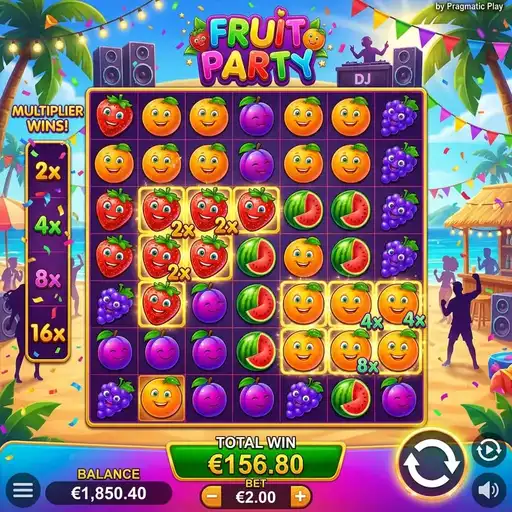
That multiplier behaviour gives Fruit Party a sharper feel than a plain cluster slot. A tumble chain can clear several groups and still pay little if the multipliers miss the winning positions. Another spin can change quickly when a cluster lands through two useful multiplier spots. The slot is easy to watch, but the payout logic is not flat.
Bonus Buy is available and opens the free spins round directly. The feature is where the random multiplier system gets more room to matter, because more spins mean more chances for clusters to meet strong positions. Direct entry still carries variance. A bought round can look active without producing much if the grid keeps clearing away from multiplier spots.
The visual clarity helps the game. Fruit symbols are easy to separate, and multiplier markers stand out enough that the player can follow why one cluster became valuable. That matters in a 7x7 slot because tumble chains can resolve quickly, especially when several small clusters clear in one paid spin.
Fruit Party Math Profile
Fruit Party lists 96.5% RTP with high volatility. That pairing makes sense for a slot where random multiplier placement can decide whether a round stays ordinary or becomes a real hit. The 5,000x ceiling is not extreme by modern standards, but it is enough for the feature to carry the game.
The stake range runs from 0.20 to 100. Since the math does not change with stake size, the relevant question is tolerance for high volatility cluster play. Fruit Party can provide frequent visual activity, but it is not designed as a steady low variance fruit slot.
Fruit Party Bonus Round Detail
The free spins round is stronger when multiplier positions and cluster paths start matching early. Random markers can appear in powerful places, but they need winning fruit groups to pass through them. This is the main difference between a promising looking round and a profitable one.
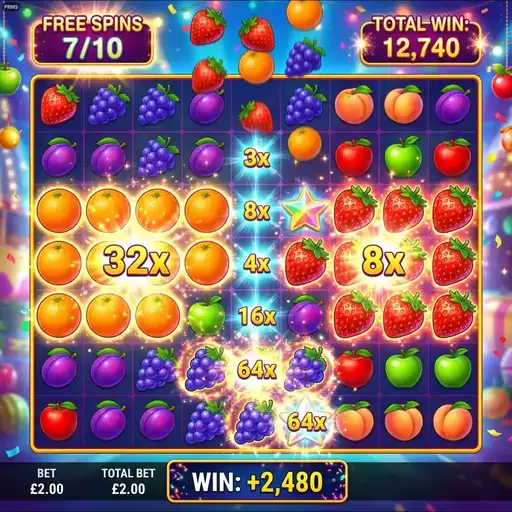
Compared with Sugar Rush, Fruit Party has less board memory. Sugar Rush builds multiplier spots across the feature, while Fruit Party relies more on random position timing. That makes Fruit Party feel more immediate and more swingy. A single well placed cluster can matter quickly, but the round can also pass through several tumbles without touching the right spaces.
The bonus can retrigger, which gives the grid more time to find a strong multiplier connection. Retriggers are valuable here because the mechanic needs attempts. More spins mean more chances for high multiplier positions to align with fruit clusters instead of sitting unused.
Fruit Party Player Fit
Fruit Party suits players who like cluster slots with fast visual feedback and simple rules. It is not a classic fruit machine in the old line slot sense. The fruit symbols are familiar, but the actual game is a multiplier driven cluster product.
It is less suitable for players who want progressive board building or predictable feature steps. Fruit Party is more immediate: clusters land, positions receive multipliers and the result depends on whether those two things meet before the chain ends.
Free spins are triggered by scatter symbols, and the feature is where the random multiplier positions get enough attempts to matter. A base game spin can show the mechanic, but the bonus gives the grid more time to place several multipliers and find clusters that pass through them.
Fruit Party is strongest when several multipliers sit in connected parts of the board. A single high value marker in a dead corner can be wasted, while two medium markers in active positions can produce a better result. This is why board location matters as much as headline multiplier size.
Players coming from traditional fruit slots should understand the difference immediately. Fruit Party uses familiar symbols, but the engine is a modern cluster game. The fruit theme makes the grid easy to read; it does not make the game lower variance.
Base game rhythm can be deceptive because tumbles create constant movement. A player may see repeated cluster clears without a meaningful return when the multiplier positions are poorly placed. Fruit Party is best assessed by how often the tumbles find multiplier spots, not by how busy the grid looks.
Bonus Buy adds a direct route to the feature for players who want to inspect the multiplier system faster. It should still be treated carefully because the round can miss the useful positions. Direct access changes the pace of review, not the underlying volatility.
Verdict: Fruit Party remains a strong cluster slot because the mechanic is easy to understand and the multiplier positions create real feature pressure. The presentation is simple, but the payout route has enough volatility and clarity to justify the game's place among Pragmatic Play's better fruit themed releases.
More Pragmatic Play Slots

Rabbit Garden

3 Genie Wishes

Big Bass Splash

Gems of Serengeti

Emerald King